

Latest design of the Anderson hand rest
Posted by Trent on August 3, 2012
https://tjbassoon.com/2012/08/03/latest-design-of-the-anderson-hand-rest/
Custom crutches
I’m a convert.
For years of not using a right hand rest I finally had a conversation with Chris Schaub that convinced me to switch to using one. But I can’t be too simple. I used the rest that came with my Moosmann for a while, but then got thinking about more ergonomic designs. I had Eric Anderson at Midwest Musical Imports carve me a crutch to my specifications using a clay mold as an idea. That first crutch now belongs to Lecolion Washington and I have #2. Which looks like this:
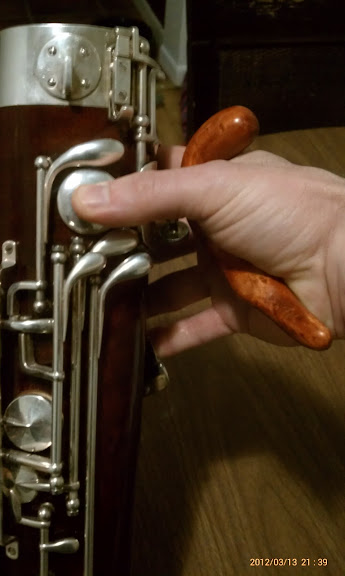
I’ve trimmed it down a bit, but Eric has continued improving on the design and has sold a few to some others. I’ll post pictures of the new one once the pin is put in place.
The whole point of the crutch is to allow the instrument to be controlled by your hand farther away from the joints of your fingers. My technique improved in my right hand dramatically as soon as I switched to a standard crutch, and these are even better. The control point is shifted to the center of your palm, as far away from your finger joints as you’re really going to get.
Posted by Trent on July 30, 2012
https://tjbassoon.com/2012/07/30/custom-crutches/
What does that thing sound like anyway?
Well, here’s some demonstrations of some various effects used on the bassoon.
Posted by Trent on March 19, 2012
https://tjbassoon.com/2012/03/19/what-does-that-thing-sound-like-anyway/
Brahms Violin Concerto
The The adagio movement 2nd bassoon part of the violin concerto is almost always on every audition for any position, principal or not. Part of the key to playing this right is making a musical partner with the oboe. Even having played this in concert I still find that I don’t have the oboe part in my head well enough, so I made a score rendition of the 2nd bassoon part along with the oboe solo. Probably handy for oboe players too, to see what is happening underneath with harmonic implications.
So here it is: Brahms Violin Concerto Excerpt with oboe
Posted by Trent on August 26, 2011
https://tjbassoon.com/2011/08/26/brahms/
Successful saxophone test!
We’ve determined the Little Jake works great on tenor saxophone. It only requires a modification to the mouthpiece, where a hole is drilled and a threaded tap made. The ideal place is likely in the neck area, but this only requires an extra mouthpiece (and a ligature that won’t get in the way).
The sound was very promising. When I had Brandon Wozniak test this on his saxophone when we turned the amp on it was just like increasing the volume on the instrument. The tone was very transparent, it was even difficult to tell it was on except that it was unnaturally loud. Effects worked very well too.
I’ll modify your mouthpiece for free if you send it to me when ordering a Little-Jake. I would say this would be fine on Alto sax or larger, and I can only do this on plastic or hard rubber mouthpieces (not metal). Soprano sax mouthpieces are probably too small – the ligature would get in the way if there’s even a good acoustic place for it. For soprano sax modifying the neck is still probably the only option.
Posted by Trent on August 1, 2011
https://tjbassoon.com/2011/08/01/successful-saxophone-test/
Harmonic flagolet key for bassoon bocal (high G key)
I had Eric Anderson at Midwest Musical Imports custom design and build this mechanism for a Wolf bocal that I have. The idea was to create a key that opens a pinhole drilled in the bocal, operated by the right hand, and have the entire mechanism completely independent of the rest of the bassoon.

Posted by Trent on May 27, 2011
https://tjbassoon.com/2011/05/27/harmonic-flagolet-key-for-bassoon-bocal-high-g-key/
Reed Making: how I do it, part 3.
Now we have a completed blank, we need to make it fit the mandrel by reaming, make the collar nice, then finally scrape on the blade. You’ll also find out that I’m a big cheater here.
Posted by Trent on February 13, 2011
https://tjbassoon.com/2011/02/13/reed-making-how-i-do-it-part-3/
Reed Making: how I do it, part 2.
Picking up where my previous post leaves off, we now have a piece of cane folded over and the tube made round. We still have to seal the tube up and create a fulcrum to maintain the tip opening by beveling and putting on the wires. Then we wrap the turban and seal with Duco cement.
Posted by Trent on February 13, 2011
https://tjbassoon.com/2011/02/13/reed-making-how-i-do-it-part-2/
DMA Done
Finishing up the last bits of depositing my thesis. Here’s the final version on scribd:
http://www.scribd.com/doc/48614271/Elements-of-Jazz-in-Bassoon-Solo-Repertoire
Yay!
Scribd is kinda lame. Nevermind. I’ll just host it locally.
https://tjbassoon.com/wp-content/uploads/2011/05/thesis.pdf
In sad news The Magnetrons broke up. Boo…. Oh well.
Posted by Trent on February 13, 2011
https://tjbassoon.com/2011/02/13/dma-done/
 Trent Jacobs, bassoonist